


The Case for Sovereign E-Markets


CONTEXT: Economies Have Disruptive New Plumbing
Since the 2010's, traditional markets - for labor, finance, goods and services - have been displaced by online platforms. Uber's sidelining of taxi firms around the world is just a tip of this upheaval. Economic activity now flows through gig work apps, workforce scheduling systems, supply chain servers, retail sites, delivery intermediaries and Wall Street's new exchanges.
This remodeled economic infrastructure is convenient; but not fair, stable or efficient at utilizing resources. It comprises thousands of sophisticated, opaque, platforms, mainly multinational. Each is structured around its owners' needs. Priorities include cutting labor costs, edging up prices, locking in users, maximizing valuations and financial speculation.
It's easy to overlook what economic platforms are doing to us. Official data misses the impact. The higher-paid still largely enjoy regular pay. Wrongdoing by social media companies is often more relatable. AI generates headlines. But for fungible workers and businesses, these platforms form a ubiquitous membrane between each earner and their economy.


Click any cutting to see the full story
Coverage of our work


E-MARKETS: Bad at the Base, Empowering an Elite
Instead of direct customers, or a steady job, businesses and people at the base increasingly earn through skewed markets:
-
Employee Scheduling Systems: Tools like Workforce Central 8 run a monopsony labor market for each corporate customer. They can call staff in and send them home in line with precise hour-by-hour needs of the business.
-
Gig Work Apps: Uber's valuations make it a pathfinder. They mislead workers and invest to overturn worker rights. For this service they retain 30% of your earnings, or more.
-
New Intermediaries: You run a neighborhood eatery? Massive subsidies likely attracted customers to buy through one of countless delivery apps. They suck your revenue.
-
"Maker" Platforms: Maybe start a small business? Corporate sellers are favored on platforms including eBay and Etsy. The dominant Amazon Marketplace can use your data to launch its own products competing against you.
In contrast, Wall Street used digital platforms to shape a new era of open, interlinked, ultra-low overhead, data rich, solid, regulated, markets. Resources gravitate to efficient markets. So, capital siphons out of real economies into financial trading.
AI is turbocharging both financial exchanges and extractive, controlling, "markets" where most of us now connect to demand.


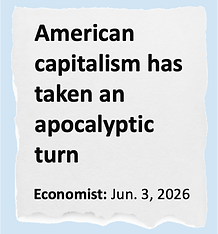
POLITICS: Raging Voters, Capitalism in Crisis
Injustice embedded in today's economic plumbing remains hard to dissect, but easy to intuit for those on the receiving end. It helps explain why, across 30 countries, 68% of voters believe "My economy is rigged". Separate 2025 research established 40% now see violence against the economic system as justifiable.
Multiple reasons are cited for hatred of contemporary capitalism; precariousness, inequality, bank bail outs, flatlining wages, globalization, outsourcing, climate abuse. Today's economic platforms are an enabling architecture for all of them. Every day they extract wealth, undermine stability and drive businesses towards pools of commoditized, cheapened, controllable labor.
Campaigners strive to tame the excesses of platforms. But "fair work week" acts, platform governance rules, antitrust initiatives, and other steps can be subverted by secretive algorithms or lobbying. In digitized capitalism, whoever controls the arteries sets the rules. Right now, that's Silicon Valley and Wall Street.


POLICY: A New Economic Engine for Uncertain Times
It is extraordinary what today's market technologies could be doing to foster equitable, inclusive, lowest-overhead, resource-efficient capitalism. Any country can incentivize corporates to fund a comprehensive system of regulated e-markets across its economy. It costs nothing and widens everyone's choices. It's ambitious but, done right, could attract huge usage.
Imagine a sophisticated market platform packed with new functionality to maximize any user's income, opportunity and options. Within their rules, it can:
-
trade hours they want to work across their entire range of abilities, with full protections and benefits
-
rent out possessions
-
construct job opportunities and other possibilities
-
lend/borrow cash to/from peers
-
interact directly with official facilities.
Crucially, this is a horizontal system of national markets, not the global verticals of today.
This platform can provide constant, localized, like-for-like, data about demand, supply, and earnings across thousands of microeconomic sectors. It can use those insights to incentivize market-aligning investment in upskilling, or trigger interventions for a struggler. Operating at huge scale with ultra-low charges, the joined-up markets it offers are open, decentralized, transparent, neutral and relentlessly focused on maximizing economic potential for any individual or business who wants to use their new public utility.

LOGIC: Extending Digital Public Infrastructure
Companies like Uber have no need, remit or unique leverage to initiate all-sectors, genuinely empowering, markets. Governments have all those things. They are on their way with initiatives like Brazil's Pix payments platform, used by 80% of voters. Many countries seek sovereign AI. Others plan a Central Bank Digital Currency for citizens wanting modern money backed by their state rather than a startup.
How does a government go the next step; initiating a system of national end-to-end e-markets for anyone to use if they wish? An official concession, like the ones that get corporates competing to fund, then run, national or state lotteries for a small cut of turnover.
A focus on low-value transactions must be mandated. This fosters access, fairness, precision matching and fine-grained data. Atomized activity then opens newly granular social safety nets and financial services while boosting resilience, greening, government efficiency and competitiveness.
Competing providers offering AI on this architecture should lead to income maximization tools and the rise of human capital as an asset class, attracting investors with data, risk mitigation and market solidity to equal Wall Street's new exchanges. For activists, policymakers or business leaders ready to take back control of market economies from international opportunists, there are exciting possibilities.

ABOUT: Thirty Years' Development
An officially instigated markets platform could become monolithic, anticompetitive or sclerotic. Our apolitical nonprofit works with technologists, academics, campaign groups, policymakers and others to identify these pitfalls. We then research how they can be prevented in technology and a framework of enabling legislation.
We emerged from a project at the UK Demos thinktank during the 1990's. Now we are best known as initiators of government programs that piloted a radical new labor market platform in both Britain and the US. Our wider work has produced books, countless articles and policy papers for think tanks on the anti-poverty left, the free market right and waypoints between.
Vibrant, participatory, "People's Capitalism" has been a grail for strategists on right and left over decades. Regulation, restructuring of businesses, subservient robots, wider stock ownership and other paths get proposed. But new market technologies could lastingly atomize economic opportunity far beyond these tweaks.
Other potent technologies - electricity, money, roads, water supply, railways - started in a scramble of startups. Then campaigners persuaded a first government to launch a public utility version which was widely preferred. Improved equality, growth and innovation followed.
E-markets meet the historic criteria justifying a public utility version. Other digital services don't. We relentlessly ask: What could modern markets do if maximizing income for households and local businesses was their priority? And how do we get there?
Sign up for our newsletter or browse our research briefs.

(c) 2026 MM4A (Modern Markets for All) Nonprofit - All content released under a Creative Commons CC BY licence